
What Disturbed Perception Reveals. Art, Suffering, and the Philosophy of Seeing #415
Guest article by Tunacan Tuna

Dear friends of Daily Philosophy,
I received an email a few days ago from a reader who had suspicions about one of our articles having been written by AI. They had tested the article with an AI detecting program online, which had confirmed that the article had been written by AI. And they expressed their disappointment that DP now publishes AI-written articles.
Since I think that this is a very important topic, I started writing a reply right here, in this article you are reading now. After half an hour or so, my draft had reached three pages, and I knew that I would not be able to publish it together with today’s article without the whole thing becoming a book. So I will send you my reply next week, as an article of its own. There is a lot to say about the topic, obviously, and every possible answer gets it wrong in some way. It is, I believe, as always in ethics (and here already many will disagree), a matter of personal (and political) taste which values one chooses as desirable, which world one judges as good to live in. I don’t believe that there is an objective goodness or badness to AI, there are just trade-offs, and every one of us must decide which outcomes and values are important to them. My short answer to the allegation was that I have as of now never knowingly published an AI-written article on DP, except where it was clearly stated as an AI experiment. If an author managed to smuggle an AI-written article into DP, they did so without my knowledge.
We will talk more about that next week. For today, let me welcome Istanbul-based artist and culture writer Tunacan Tuna, who, in today’s very interesting article, examines what we can learn from disturbing (and disturbed), very human, art.
Have a great weekend! — Andy
What Disturbed Perception Reveals
By Tunacan Tuna
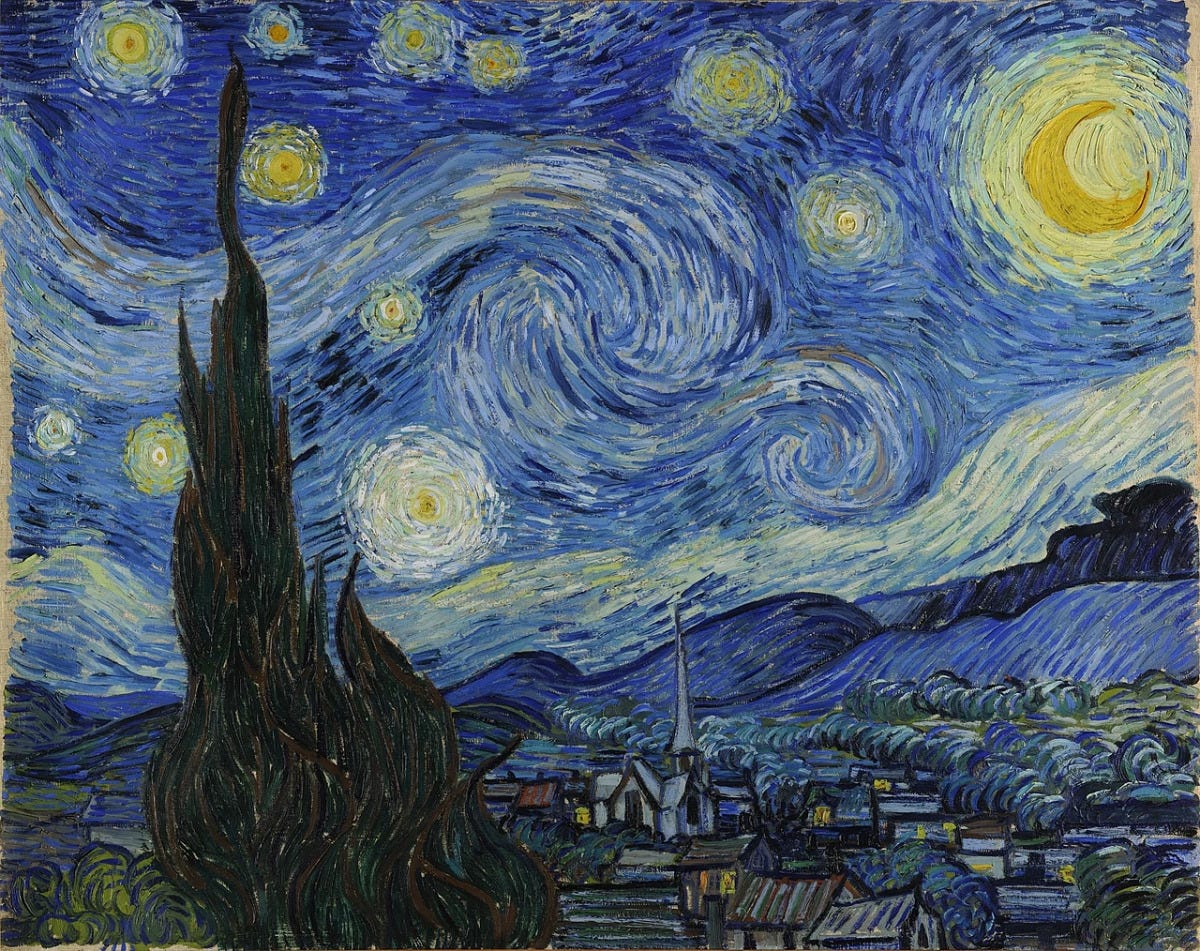
When we stand before The Starry Night and feel something we cannot quite name, we tend to attribute it to the painting’s beauty. But there is a harder question lurking behind our aesthetic response: what kind of mind produced this, and does it matter?
Vincent van Gogh painted that churning, electric sky after admitting himself to the asylum at Saint-Rémy. He was, at the time, suffering from severe mental distress that has since been variously interpreted through diagnoses including mood disorders, epilepsy, and psychotic episodes. The question this raises is not merely psychological. It is a genuinely philosophical one, and it belongs to one of the oldest debates in aesthetics: Is art the expression of truth, and if so, what kind of mind can access it?
Plato was deeply suspicious of art precisely because he thought it dealt in appearances rather than essences. But there is an irony here. If we take seriously the testimony of artists like Van Gogh, who described moments of perception with almost unbearable intensity, then we might ask whether the distorted sky in The Starry Night is less accurate than a photograph, or more. The photograph captures what the eye measures. Van Gogh captured what the mind feels the sky to be. Whose account of the night is truer?
The photograph captures what the eye measures. Van Gogh captured what the mind feels the sky to be. Whose account of the night is truer?
This is not an idle question. Aristotle, in the Poetics, argued that poetry and art are more philosophical than history, because they deal with universals rather than particulars. History tells us what happened; art tells us what tends to happen, what is possible, what is meaningful. On this account, the distortions in Van Gogh’s work are not failures of perception. They are precisely the kind of intensification that makes art philosophically serious. The gale in his brushstrokes is not a symptom reduced to illness; it is a report from a state of experience that the rest of us only briefly glimpse.
The same tension runs through the work of Francisco Goya. After illness left him deaf and profoundly altered his inner life, Goya painted the series now known as the Black Paintings directly onto the walls of his house. These images were so dark and private that they were not originally intended for public view. The most notorious, Saturn Devouring His Son, uses the thin excuse of mythology to paint something far more intimate: the mind’s own terror of its destructive impulses. There is a concept in existentialist philosophy, explored with particular depth by Kierkegaard, called the dread of possibility: the anxiety that comes not from any particular threat but from the sheer openness of what one might do or become. Goya, it seems, had arrived at that place. His Saturn does not frighten us because it depicts a monster. It frightens us because it depicts something we recognise.
Edvard Munch was more explicit about the connection between his inner life and his images. He described in his diary the evening that gave birth to The Scream: the sudden sensation, walking with friends, that the sky was screaming through him while the world went on utterly indifferent. His companions continued walking. This moment captures, almost diagrammatically, what phenomenologists call the breakdown of the lifeworld: the shattering of our normal, unreflective immersion in shared experience. We move through the world taking for granted that our perceptions and those of the people beside us roughly coincide. In a panic attack, that assumption collapses. The self is suddenly marooned inside its own experience with no bridge to the world outside. Munch did not describe this experience. He painted it. The figure’s face, that almost embryonic distortion, and the two calm companions walking on, are as precise a philosophical diagram as anything Husserl committed to text.
Goya’s Saturn does not frighten us because it depicts a monster. It frightens us because it depicts something we recognise.
Then there is Louis Wain, the English illustrator whose later work has often been interpreted through the lens of schizophrenia and altered perception. Across decades of work, the cats for which he became famous appear to undergo a gradual visual transformation. He began drawing animals with warmth and naturalistic precision. In later works, the cats become increasingly abstract: their anatomy dissolves into electric, symmetrical, fractal-like patterns that belong to no visible world. What Wain’s progression has often been read as describing, whether intentionally or not, is the philosophical problem of the boundaries of the self. In ordinary consciousness, we take for granted that there is a distinction between the perceiver and the perceived, between the cat and the eye that sees it. In psychotic experience, that boundary may become porous or disappear entirely. Wain’s later cats are not simply failed representations of a cat. They are images of perception dissolving into the thing perceived.
What all these artists share is not simply suffering, which of course produces no art at all by itself, but a form of suffering that broke open the usually sealed compartments of experience. The philosopher Simone Weil wrote that affliction, a word she used to distinguish genuine, grinding suffering from mere discomfort, strips away the social and psychological scaffolding that ordinarily insulates us from reality. Whether this produces wisdom or devastation, she argued, depends on what the afflicted person does with the stripping. Van Gogh, Goya, Munch, and Wain, each in their own way, did something with it. They externalised it. They made it visible.
Mental illness is neither a prerequisite for artistic greatness nor a guarantee of insight.
This is, in the end, the philosophical value of these works: not as case studies in abnormal psychology, and not as proof that madness is a prerequisite for greatness. It is not. The suffering was real and often catastrophic for those who lived it. Their value lies in the fact that they give us, from the outside, access to states of mind that philosophy has tried to describe from the inside for centuries. When Munch paints the sky on the night of a panic attack, he is doing phenomenology. When Goya paints Saturn, he is doing existential philosophy. When Van Gogh paints a night that will not keep still, he is asking the same question Plato asked about art, and answering it differently.
To recognise this is not to romanticise suffering. Mental illness is neither a prerequisite for artistic greatness nor a guarantee of insight. The suffering endured by these artists was often devastating. Yet their works remain valuable because they preserve experiences that are otherwise difficult to describe, allowing us to encounter forms of perception that would remain inaccessible through ordinary language alone.
Perhaps the deepest philosophical claim concealed in these images is this: that ordinary perception, with its comfortable stability and its reasonable distances, may itself involve a kind of selective blindness. The minds that struggled to maintain that stability sometimes illuminated aspects of experience that ordinary perception leaves in the background. What they left us is not evidence of what it is to be ill. It is evidence of what it is to be awake.
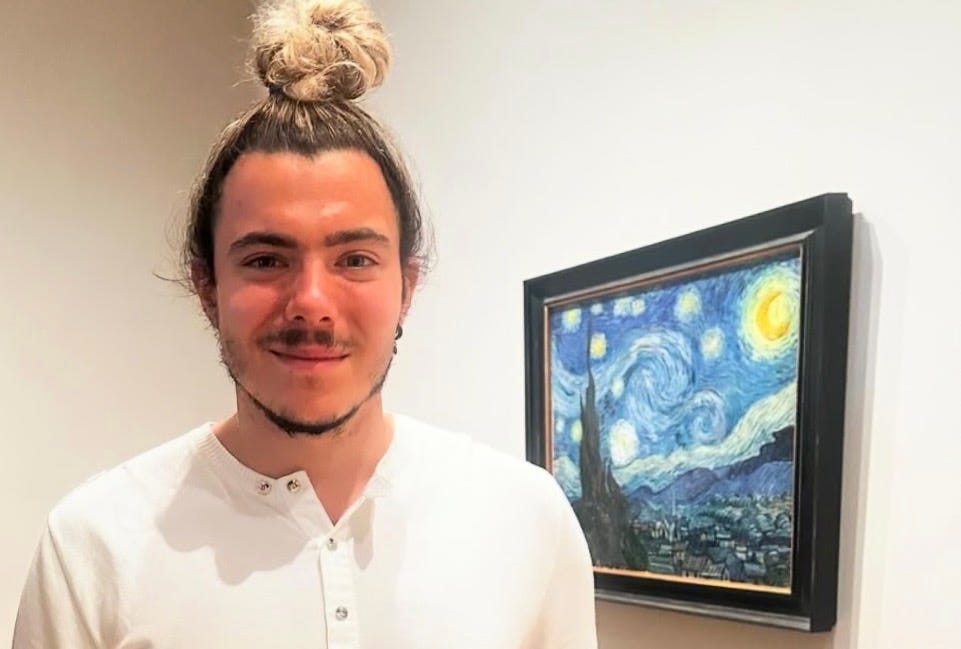
Tunacan Tuna is an Istanbul-based culture writer, journalist, and radio host, and a postgraduate researcher in Culture and Arts Management at Yıldız Technical University. He writes on cultural memory, art history, museums, and the philosophy of perception for international publications including DailyArt Magazine, New Eastern Europe, Interlude.hk, and TürkTime, with a particular interest in how images carry emotional and philosophical meaning across time. His work moves between aesthetics, heritage, and the sociology of culture, exploring what art reveals about the minds that make it. He can be reached through his website, tunacantuuna.com, and on Instagram at @tunacantuuna.