
Easy and Stunning Timelines for Your Classes #418
Taking advantage of the enemy's weapons

Maybe every life is equally a series of disappointments, but certainly the academic career is.
While still in secondary school, I imagined how great it would be to study at a famous university, to learn all those wonderful thoughts that occupied mankind’s greatest minds, to be steeped in the wisdom and knowledge of the ages. The only thing worth doing turned out to be discussing with one’s friends over a few beers in a pub in the evenings. The lectures were dull, pointless affairs, best skipped entirely, and my only vivid memory of a seminar is from the day when I had not managed to finish my presentation in time, earning me the wrath of the short-tempered instructor. Our professors gave the impression that they would rather have their teeth polished at the dentist than spend an hour talking to us. The most inspiring of the lot was an old alcoholic, an expert in Kant, whom I once escorted home from the pub because he wasn’t able to give his address to a taxi driver any more. We stumbled around the dark streets, going in circles for an hour, trying to work out where he lived. At one point he looked up and his face lit up with recognition. We had just arrived back at the pub, and it turned out that he lived right across the street from it. A few years later, his cousin, another famous professor, married my first girlfriend and I became, so to speak, part of the family. I learned that the lost-at-the-pub thing was a trick the Kant expert regularly played on his first year students, to his endless amusement every time.
This might seem a bit extreme, but they were not bad people. I loved most of them: The one who chain-smoked in the classroom while quoting long passages of the Early Modern philosophers from memory (we were checking by following the quotations in the book — he never made a mistake or missed a word); the one who never knew any philosophy and whom we pitied because he was such a miserable figure — but he was the nicest of the lot to us, grateful to learn something from us every time we talked to him; the one who never worked his way out of an assistant role, and who, for years, had only the one job of advising students on their study plans and trying to get LaTeX to typeset his papers in an obscure Asian language, until he died of a heart attack still sitting at his advising desk. They were colourful, exciting figures, and I got myself a long pink gown because my Nobel-prize laureate biochemistry professor used to teach us wearing one just like it.
What strikes me as I recall my years of studying is how little of what I remember has anything to do with the content itself. I remember professors not for what they taught me, but for their clothes, their antics, their dad jokes (“the plastids inside the cell — the chloroplast, the leukoplast, the Hansaplast,” followed by a slide of a bandaged finger), and sometimes I wonder what my students will remember me for. And now that I think of it, I fear that my colleagues of today are a lot less remarkable and interesting than my own teachers were back then. Who smokes in class today, who makes fun of students by pretending to be unable to return home from the pub, who marries his student’s girl, who teaches in a long pink gown? It seems that the world is not only losing its species, its democratic institutions and its future at an alarming rate, it is also losing its character, the colourful figures that used to populate it and make it fun and worthwhile to live in.
My colleagues of today are sleek, grey professionals, soft-spoken lecturing robots, competent, helpful, prolific in creating papers and memos. But would they live barefoot in a barrel? Write a poem on a beach in Thailand? Get inspiration from a mescaline trip? Teach prowling the streets of Hong Kong, engaging the city officials in public debates among the wet market stalls? Would any young student actually want to become like them?
Don’t ask me how we ended up here, by the way. I mean in this article. I was just trying to come up with an introduction to a post about using AI in teaching. And now I don’t quite know how to make it go there. How to write that bridge between the rose-tinted memories of a 1980s German philosophy student — to how one could use today’s AI (unimaginable scifi back then!) to teach better classes? Well, let me try it this way: If today we can’t smoke or get drunk or pink-gowned in our classrooms, does this mean that we have to bore our students out of their skulls by just standing there and talking? At a time when our students read less and less, and their attention spans are measured in minutes, do we really have to force them to suffer their way through 600 pages of Russell’s History of Western Philosophy or 90 minutes of a talking head experience twice a week? Do our slides really have to look like someone unearthed them together with the Red Sea scrolls? Or is there a better way?
Stupid question. Of course there is. Read on.
AI to the Rescue
In this and in the following few posts (by the way, written on a folding chair, on a Greek beach, which may explain the somewhat wild style), I want to explore how we can create better, more engaging teaching materials for better, more engaging classes for our students. The motivation is entirely selfish: I have a ton of classes next term, and I’m in dire need of better materials. Students don’t read anymore, so people say, and they cheat their way through their exams and written assignments by using AI. So perhaps it’s time to hit back. If they can use AI, so can we. Maybe we just need to beat them at their own game, to fight them using their own weapons. And, don’t worry: I have a future post ready about how to get students to not cheat using AI. It’s coming. Subscribe to read it. Go ahead. Make my day:
Okay, with that out of the way, here we go.
Timelines
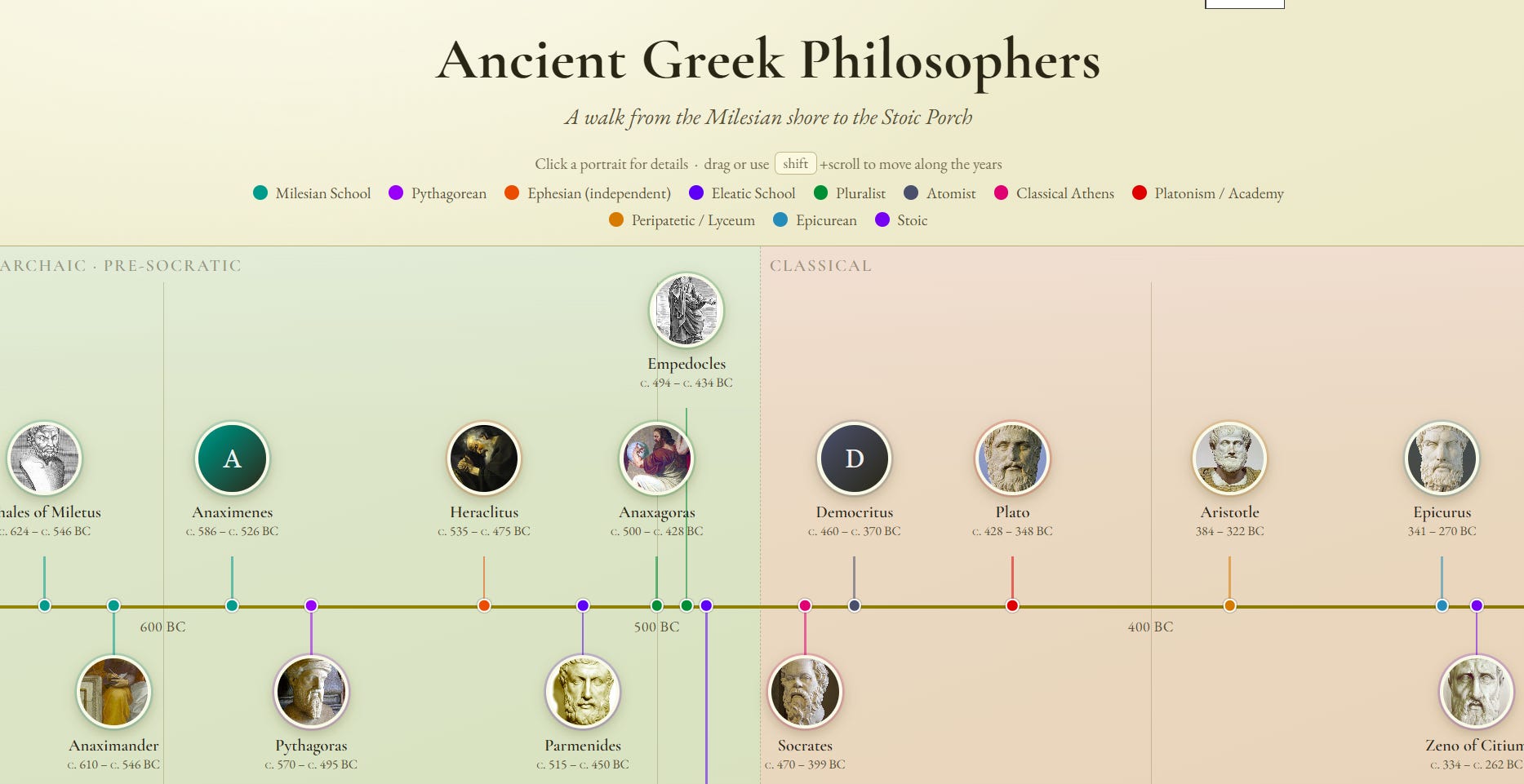
One of the things that I find most difficult to both visualise myself and to get into the brains of my students are the chronological relationships between philosophers.
Leaving aside the question why God decided to create Anaximander, Anaximenes and Anaxagoras all in the same time period, and thus make life unbearable for the undergraduate philosopher, it is also puzzling how these people all relate to each other. Who was whose student? Who was really, time-wise, a pre-Socratic and who wasn’t? Could Pythagoras have influenced Plato, or was it the other way round? Could Diogenes, the barrel-man, ever have met Socrates, and what would they have talked about?
